
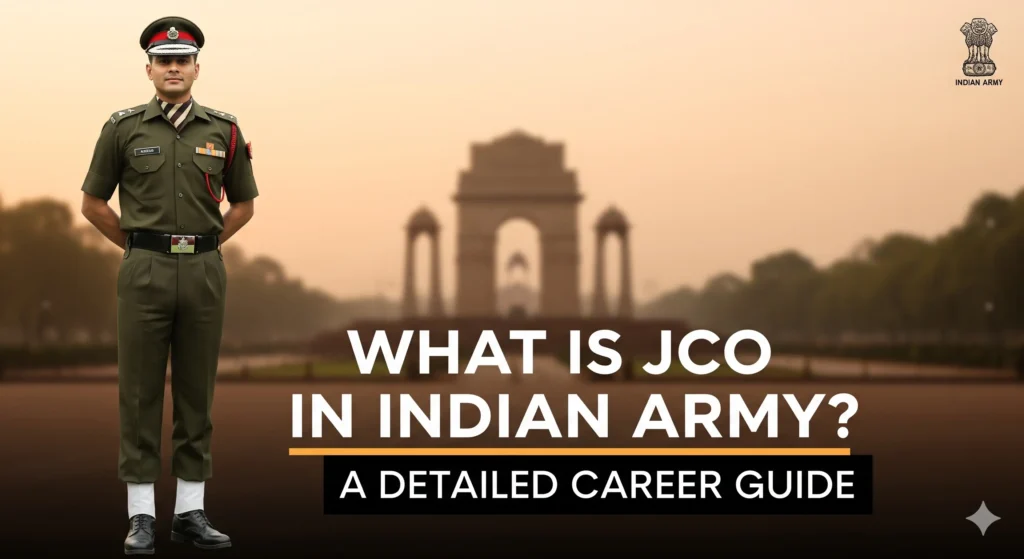
If you’ve ever watched a parade or seen an Army unit in action, you might’ve noticed officers in front, jawans in formation, and a distinct group right in the middle — the backbone of the team, the ones who hold the whole structure steady. Those are the Junior Commissioned Officers, better known as JCOs. And honestly, many young aspirants feel curious yet slightly confused about this rank. What exactly is a JCO? How do you become one? What kind of authority, respect, and duties do they carry?
Think of this guide like a relaxed but deeply informative conversation — the kind you’d have with a senior who sits you down and breaks the whole thing in a straightforward way. No heavy jargon, no complicated definitions. Just a clean, honest walk-through of what the JCO rank truly represents in the Indian Army.
So let’s dig in and clear every doubt you might have.
Who Exactly Is a JCO in the Indian Army?
A Junior Commissioned Officer (JCO) is a highly respected rank category that sits between Non-Commissioned Officers (NCOs) and Commissioned Officers. They’re often described as the “middle leadership layer,” but that simple description doesn’t fully capture their role.
A JCO is:
- A leader
- A mentor
- A problem-solver
- A disciplinarian
- A bridge between jawans and officers
They carry decades of experience, trusted judgement, and a kind of natural authority that comes only from years of service.
JCOs are not just senior soldiers — they’re leaders whose words carry weight, whose presence maintains order, and whose decisions often shape mission execution on ground.
Why Are JCOs So Important?
The Indian Army is massive, and to keep such a huge force running smoothly, you need layers of leadership. JCOs form the solid core that maintains discipline, guides troops, and implements instructions effectively.
They ensure:
- Smooth communication between officers and jawans
- Proper training standards
- Maintenance of discipline
- Welfare of soldiers
- Execution of operational orders
- On-ground tactical coordination
When officers plan strategies and jawans execute them, JCOs act as the sturdy bridge in between.
Different JCO Ranks (From Lowest to Highest)
The JCO category has multiple ranks, each carrying increasing authority and responsibility. Here’s the structure:
1. Naib Subedar
This is the entry-level JCO rank. After years of solid service as an NCO, a soldier is promoted to this rank. Even at this level, the respect commanded is huge.
2. Subedar
With more experience and leadership maturity, a Naib Subedar rises to Subedar. This is where decision-making and operational involvement deepen significantly.
3. Subedar Major
The highest and most prestigious JCO rank.
Subedar Majors are considered the “guardian pillars” of their units. They guide officers, maintain discipline, and command immense respect.
A Subedar Major’s words can shape morale, solve conflicts, and influence the unit’s overall effectiveness. Their guidance is regarded almost like a moral compass inside the regiment.
How Does a Soldier Become a JCO?
Becoming a JCO is not an overnight thing. It’s a slow rise built on:
- Years of service
- Consistent discipline
- High performance
- Strong leadership qualities
- Good conduct
- Physical and mental fitness
- Unit recommendations
The promotion path generally looks like this:
Sepoy → Lance Naik → Naik → Havildar → Naib Subedar (JCO)
After reaching Havildar, the soldier becomes eligible for JCO promotions based on vacancies and performance evaluations.
It’s a journey of dedication, not shortcuts. And that’s exactly why the rank carries such deep respect.
Daily Duties and Responsibilities of a JCO
A JCO’s everyday role blends administration, discipline, mentoring, and operational leadership.
1. Maintaining Discipline
JCOs ensure that soldiers follow proper conduct, maintain punctuality, wear uniforms correctly, and uphold Army values.
2. Guiding and Training Troops
They supervise drills, inspections, training routines, firing practice, and physical activities.
3. Solving Unit-Level Problems
A JCO often handles issues before they escalate — personal conflicts, welfare concerns, and discipline matters.
4. Acting as the Voice of Jawans
When jawans face practical problems or grievances, JCOs raise them to officers with clear communication.
5. Supervising Operations
In field situations, JCOs execute tactical instructions and ensure units perform effectively and safely.
6. Maintaining Unit Morale
They motivate, encourage, and stabilise the emotional climate of troops — a job requiring deep experience and empathy.
Their role is not small at all — it’s one of the most vital parts of how the Army stays strong and well-organized.
Privileges and Respect Enjoyed by JCOs
Because the rank is earned through long, dedicated service, JCOs receive significant privileges.
1. Separate Living Quarters
JCOs get their own living provisions and mess facilities, distinct from ORs (Other Ranks).
2. Ceremonial Importance
They lead parade formations, receive special honors, and often represent the unit in various functions.
3. Salary & Allowances
Their pay scale is higher than NCOs, along with various allowances based on posting and duties.
4. Influence & Recognition
A JCO’s opinion carries weight, and their leadership is respected by both juniors and officers.
5. Direct Interaction With Officers
They work closely with commanding officers, shaping policies and day-to-day functioning.
The level of trust placed in a JCO is huge — and it’s earned, not gifted.
Difference Between JCOs and Commissioned Officers
Many candidates mix up these two ranks, so let’s clear it up.
Commissioned Officers:
- Enter through exams like NDA, CDS, ACC, TGC
- Hold ranks from Lieutenant to General
- Responsible for command, strategy, planning, and high-level decisions
JCOs:
- Rise through the ranks from soldier level
- Lead troops at ground level
- Maintain discipline and coordination
- Serve as the core leadership that keeps everything stable
Both are vital, but their leadership styles and responsibilities differ in scope.
How JCOs Shape the Culture of Their Unit
Every unit has its own atmosphere — disciplined, sharp, respectful, strong.
A huge part of that culture comes from the JCOs.
They influence:
- Team discipline
- Training quality
- Work ethic
- Morale
- Unity
- Conflict resolution
When a Subedar Major walks into a room, everyone stands straighter — not out of fear, but deep respect. That’s the kind of presence decades of service builds.
Misconceptions About JCOs — Cleared!
Let’s bust a few myths that often circulate among aspirants:
Myth 1: JCOs don’t have real authority
Wrong. Their authority is one of the strongest in day-to-day operations.
Myth 2: Only officers make important decisions
Reality: Many key on-ground decisions are guided, shaped, or refined by JCOs.
Myth 3: Promotion to JCO is based only on seniority
Not true. Performance, conduct, and leadership matter a lot.
Myth 4: JCO life is easy
Nope. Their work is constant and demands a lot of balance, judgement, and responsibility.
Clearing these miskonceptions helps candidates respect the rank even more.
Why Many Soldiers Dream of Becoming a JCO
Because it represents:
- Honor
- Responsibility
- Stability
- Respect
- Influence
- Experience-based leadership
For many, becoming a JCO is a moment of immense pride — the kind that defines their entire military journey.
Conclusion
The JCO rank in the Indian Army isn’t just a middle-level position — it’s a symbol of trust, discipline, and experience. JCOs are the steady hands that hold units together, the guiding voices that shape soldiers, and the living examples of dedication that younger troops look up to. If you’re dreaming of joining the Army, understanding the importance of JCOs gives you a deeper appreciation for how the force truly operates.
Their journey teaches one powerful lesson: leadership is not always about stars on the shoulder — sometimes it’s about the respect you earn slowly, day by day, through honest work and unshakeable consistency. And that’s exactly what the JCO rank stands for.
You can rise to that level too, if you stay disciplined, patient, and genuinely committed to your growth — even when the path feels long or exhawsting.
Leadership is practiced not in words, but in attitude and in actions. — Harold S. Geneen