
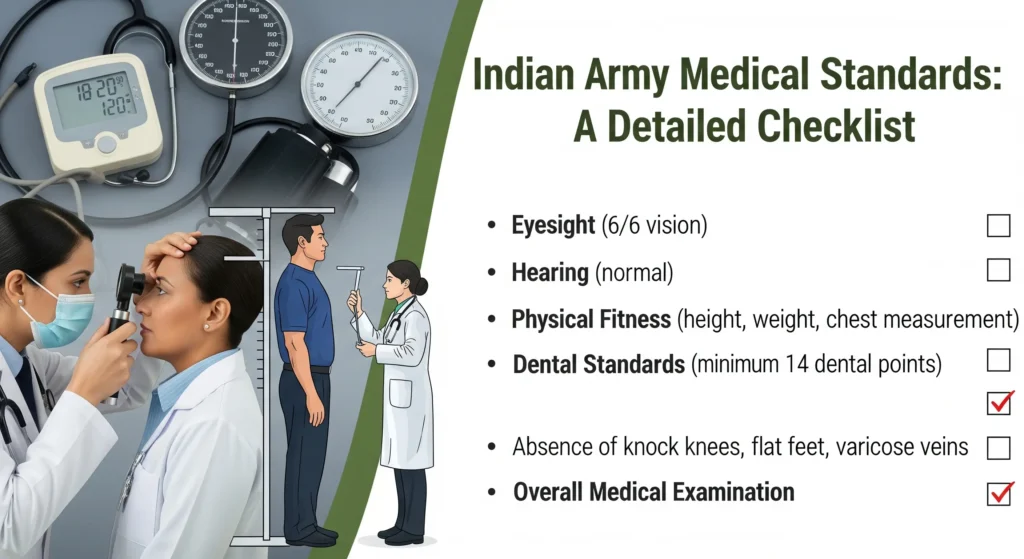
Complete Indian Army Medical Standards: A Detailed Checklist for All Candidates
There’s something about preparing for the Indian Army that hits diferently. It’s not like studying for a regular test or getting ready for a college interview. It feels bigger — heavier in a good way. You’re not just sharpening your mind; you’re shaping your entire lifestyle. And somewhere between running at dawn, doing push-ups on uneven ground, and trying to eat a clean diet when your friends are devouring pizza, you realize that the medical standards are just as important as the written exams or physical trails.
If you’re here, you probably want to understand exactly what the Indian Army expects from you medically. And honestly, that’s smart. Many candidates clear the written test and physical rounds, but the medical exam catches them off guard. This blog will walk you through every major requirement in a human, simple, and practical way — almost like we’re sitting down and discussing it over a cup of something warm.
Let’s break it all down step by step.
Understanding the Purpose of the Medical Standards
The Indian Army medical standards aren’t meant to intimidate you. They exist for a clear reason: soldiers must be healthy enough to handle unpredictable environments, tough terrains, and stressful operations. You might face cold mountains, humid jungles, or dry deserts, and your body needs to adapt without falling apart.
Think of the medical test as a filter that ensures you’ll be physically ready for the real deal. And trust me, every small detail matters — your vision, hearing, dental health, heart, lungs, and even tiny scars from childhood.
Height, Weight & Chest Measurements
Let’s start with one of the first things candidates worry about.
Minimum Height Standards
The required height varies by region and category. While most candidates need to be around 157–170 cm, certain regions receive relaxations due to natural demography.
For example:
- Gorkhas
- Candidates from the North Eastern region
- Tribal areas
These communities have officially recognized height relaxations. Don’t assume — always check the official chart.
Official and accurate info. regarding height
Weight Standards
Weight isn’t random. It must align with your height and age according to the Army’s standard chart. The goal isn’t to be thin or muscular; it’s to be balanced.
Being underweight or overweight for your height can lead to rejection. If your weight is slightly off the mark, don’t panic — small variations can sometimes be re-checked in the review medical board.
Chest Measurements
The Indian Army requires:
- A well-developed chest
- Minimum expansion of 5 cm
This doesn’t mean a gym-body, but your chest should properly expand when you breathe deeply. Practice deep breathing exercises if your expansion is barely touching the requirement — it helps more than you think.
Vision Standards (Eyesight Requirements)
Your eyes play a major role in your selection. Even if you run like a cheetah and lift like a powerlifter, poor vision can hold you back.
Unaided Vision Requirements
Most trades require:
- 6/6 in one eye
- 6/9 in the other eye
Some technical branches have stricter requirements.
Use of Glasses
Spectacles are not allowed for most combat or frontline roles. Candidates with refractive errors above a certain limit are often declared unfit.
Contacts or temporary fixes won’t work — the medical board sees right through these tricks.
Color Vision
This is a big one.
- CP-III is the minimum acceptable standard.
- Severe color blindness? Unfortunately, it results in rejection.
Color plates will be used to check this, so don’t try to memmorize color patterns. It won’t help.
Hearing Standards
Your ability to hear clearly is essential for communication, commands, and situational awareness.
You should be able to hear a forced whisper from 6 meters in both ears — and that’s the bare minimum. Conditions like wax blockage, ear infections, or perforated eardrums can also cause temporary issues, so clean your ears properly before the exam. Avoid inserting sharp objects — that could do more harm than good.
Dental Health Requirements
This might sound minor, but dental health is checked very carefully.
You must have:
- 14 dental points minimum
- Healthy gums
- No severe cavities
- No active infections
If you’ve been postponing dental treatments, now’s the time to fix them. Dental issues are among the most common reasons for medical rejection — and the saddest part? Most of them are completely preventable.
Heart & Lung Examinations
Army doctors examine your heart and lungs to check if you can withstand intense training, altitude changes, and long physical activity.
They will look for:
- Abnormal heartbeat patterns
- Asthma or breathing difficulties
- Heart murmurs
- Chest deformities
Even small issues that you never noticed may appear during these tests. Sometimes, they suggest further evaluations like ECG or X-ray. Don’t freak out — additional tests don’t equal rejection.
Musculoskeletal System (Bones, Joints & Movements)
This is where many candidates face unexpected challenges. Your bones, joints, and muscular structure must be healthy enough to endure rough training.
The exam checks for:
- Flat feet
- Knock knees
- Joint instability
- Bone deformities
- Spinal issues like scoliosis
Flat Feet
If your foot arch is missing, you may be disqualified because it affects long-distance running and carrying loads.
A quick self-test:
When your feet are wet, stand on a flat surface. If the complete footprint appears, you might have flat feet. But don’t assume — only the medical board can confirm.
Knock Knees
When you stand straight with your heels together and your knees touch excessively, that’s considered knock knees. It affects balance and running posture.
Exercises sometimes improve mild cases, but there’s no gurantee.
Skin Conditions & Tattoos
Skin Diseases
Chronic skin disorders (eczema, psoriasis, infections) can make you unfit. Even temporary infections might pause your selection until recovery.
Tattoo Policy
This is where many candidates make mistakes.
Allowed:
- Permanent tattoos on the inner forearm
- Religious or customary tattoos for specific communities
- Small-size, non-offensive tattoos
Not allowed:
- Large tattoos
- Tattoos on visible body parts
- Designs promoting violence or anything considered inappropriate
Check your tattoo placement wisely before going ahead with it.
Blood Tests, Urine Tests & Internal Health
This part is detailed but straightforward. Doctors check for:
- Diabetes
- Kidney function
- Liver function
- Blood disorders
- HIV
- Hepatitis
- Urinary infections
Most of these tests simply confirm that your internal systems are functioning properly. Drink enough water before the exam, but don’t overdo it — overhydration can affect urine results.
Mental Health & Psychological Evaluation
Even though it’s not talked about much, mental stability is crucial. The Indian Army checks whether candidates show:
- Balanced emotional behavior
- Clear thinking
- No history of severe psychological disorders
This isn’t a hard interrogation. It’s more like ensuring that you’re capable of handling stress without breaking down.
What to Carry for the Medical Test
Here’s a quick checklist:
- Original documents
- Medical reports if you were treated earlier
- A clean pair of undergarments
- Basic toiletries
- A calm mind — seriously, it helps
Avoid energy drinks, tobacco, or strange “tricks” suggested by random people. They don’t work and they might harm you.
- How to Join Indian Army 2026: The Ultimate Agniveer & JCO Recruitment Blueprint
- The Full Document Verification Checklist for Indian Army Agniveer Candidates
- What is JCO in Indian Army? A Detailed Career Guide
- Understanding Indian Army Cut-off Marks: A Comprehensive Analysis of Past Trends
- Indian Army Agniveer CEE Syllabus & Exam Pattern 2026: Everything You Need to Know
Conclusion
Preparing for the Indian Army medical test isn’t just about passing a checklist. It’s about building a body and mindset that can keep up with one of the toughest and most respected forces in the world. Every small change you make — be it fixing your posture, cleaning your diet, or going for a quick run in the evening — adds up.
And if you’re serious about wearing that uniform one day, the medical standards shouldn’t scare you. They should motivate you. Because every requirement exists to make sure you can handle the pride and pain of the journey ahead. So keep training, stay disciplined, and don’t let small setbacks define you.
You’re closer than you think.
He who sweats more in training bleeds less in battle. — Spartan Maxim