
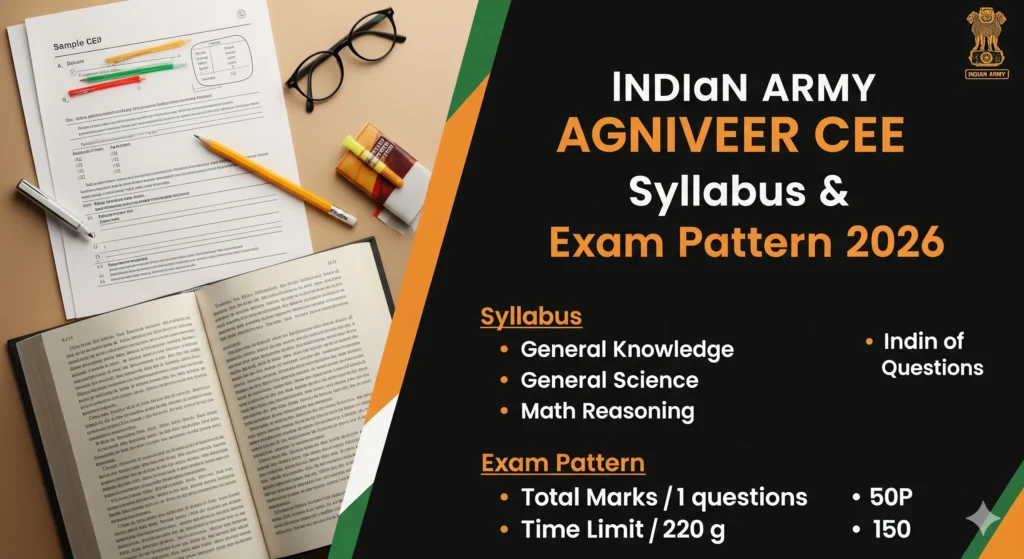
Every year, thousands of candidates gear up for the Indian Army Agniveer recruitment, and one thing that consistently creates confusion is the Common Entrance Exam (CEE). Some candidates train like beasts for the physical tests but then stumble during the written exam because they didn’t study the right topics or didn’t understand how the paper is structured. And honestly, nobody wants to lose their shot because of something as avoidable as not knowing the syllabus properly.
If you’re preparing for the 2026 cycle, this guide will walk you through the full exam pattern, marking scheme, and detailed syllabus in a simple, human, and down-to-earth way — almost like a senior guiding you through the process. We’ll break everything down so you know exactly what to focus on and how to structure your study plan without drowning in confusion.
Let’s get into the real stuff.
Understanding the Agniveer CEE Format
The Common Entrance Exam is conducted after candidates clear the physical fitness test (PFT) and medical examination. The exam varies slightly depending on the category you apply for, such as:
- Agniveer (General Duty)
- Agniveer (Technical)
- Agniveer (Clerk/Store Keeper Technical)
- Agniveer (Tradesman)
But the overall layout is pretty straightforward: objective-type questions, strict timing, and a mix of difficulty levels.
Many students underestimate the exam thinking “MCQ hi toh hai,” but that relaxed attitude can be dangerous. The paper is fast, time-bound, and needs a sharp mind.
Exam Pattern for Agniveer 2026 (Category-Wise)
Let’s break it down category by category.
1. Agniveer General Duty (GD)
- Total Questions: 50
- Total Marks: 100
- Passing Marks: Usually around 35
- Subjects Covered:
- General Knowledge
- General Science
- Mathematics
Marking Scheme
- +2 marks for every correct answer
- 0.5 negative marking for wrong answers
This exam looks simple, but the GK portion can feel tricky if you’re not updated. Many candidates lose marks here by guessing careless answers.
2. Agniveer Technical
- Total Questions: 50
- Total Marks: 200
- Subjects Covered:
- General Knowledge
- Physics
- Chemistry
- Mathematics
Marking Scheme
- +4 marks for every correct answer
- –1 for every wrong answer
The Technical paper is tougher than GD, especially because the Physics and Math portions go deeper than basic school-level concepts.
3. Agniveer Clerk / Store Keeper Technical
This category includes two separate papers.
Paper I
- Subjects: General Knowledge, General Science, Mathematics, Computer Science
- Total Marks: 100
Paper II
- Subjects: General English
- Total Marks: 100
Marking Scheme
- +4 marks for correct answers
- –1 for wrong answers
Clerk CEE is not hard but requires accuraccy. English plays a major role, so candidates who ignore grammar tend to struggle.
4. Agniveer Tradesman
There are two categories:
- 10th pass Tradesman
- 8th pass Tradesman
Exam Pattern
- Total Questions: 50
- Total Marks: 100
- Subjects:
- General Knowledge
- General Science
- Mathematics
Marking Scheme
- +2 marks for every right answer
- –0.5 for wrong answers
The Tradesman exam is simpler, but don’t assume it’s a cakewalk. Wrong guesses add up quickly because of negative marking.
Detailed Subject-Wise Syllabus for CEE 2026
Now let’s move into the most important part — the exact syllabus. Knowing what to study is half the battle won.
General Knowledge (All Categories)
GK can feel wide and confusing, but it follows a fairly steady pattern.
Topics Covered
- Indian History (Freedom struggle, major wars)
- Geography (Rivers, mountains, climate, soil)
- Indian Polity (Constitution, President, PM, Parliament)
- Current Affairs (National & international events)
- Sports (Trophies, current winners)
- Indian Culture & Traditions
- Defense-related information
- Important dates and days
- Basic economics
- Neighboring countries
A lot of candidates ignore GK thinking it’s too “vast,” but even 30 minutes daily can build a strong base over months.
General Science
This section mostly takes questions from everyday life science.
Topics Covered
- Human body
- Diseases and prevention
- Nutrition
- Biology basics
- Physics (simple machines, force, motion)
- Chemistry (elements, mixture, acid-base, metals)
- Environmental science
- Scientific discoveries
- Common scientific instruments
Most of this is around 6th–10th standard level, but the paper loves small tricky lines, so clarity matters.
Mathematics
Math is scoring if your basics are strong. Even if you’re scared of Math, consistent practice helps you crush this part.
Common Topics
- Number system
- Ratio & proportion
- LCM and HCF
- Algebra (simple equations)
- Geometry basics
- Mensuration (area & perimeter)
- Simple interest & compound interest
- Profit & loss
- Time, speed, and distance
- Average
- Percentage
- Probability (basic)
Math doesn’t require you to be a genius, just someone who practices regularly.
English (For Clerk/SKT)
English plays a huge role in Clerk exams. Candidates often lose marks because they skip grammar rules thinking it’s “too boring.”
Topics Covered
- Reading comprehension
- Synonyms & antonyms
- Error detection
- Active & passive voice
- Direct & indirect speech
- Cloze test
- Sentence improvement
- Vocabulary
- Tenses
- Articles & prepositions
- Para jumbles
Strong English can pull your overall score way up.
Physics (For Technical)
Technical candidates must revise slightly deeper concepts.
Topics Include
- Motion & laws
- Work, energy & power
- Electricity & magnetism
- Heat & temperature
- Sound waves
- Light & optics
- Modern physics basics
- Gravitation
- Pressure & fluids
Don’t ignore numerical questions — they appear more frequently than people assumme.
Chemistry (For Technical)
Chemistry is usually mixed with theory plus basic reactions.
Topics Include
- Classification of elements
- Chemical bonding
- Acids, bases, salts
- Carbon & its compounds
- Metals & non-metals
- Chemical reactions
- Environmental chemistry
- Electrochemistry basics
Simple, but needs revision to avoid silly mistakes.
Preparation Strategy for Agniveer CEE 2026
A syllabus is useless without the right strategy. Here’s how you should prepare:
1. Create a Daily Study Plan
- 1 hour GK
- 1 hour Maths
- 45 minutes Science
- 15 minutes revision
- English practice if you’re a Clerk candidate
Small daily efforts grow into massive confidence.
2. Practice Mock Tests Weekly
Mock tests reveal:
- Weak subjects
- Time pressure
- Mistakes you repeat
- Speed of solving
Many candidates avoid mock tests because they’re afraid of low scores. But that fear stops your growth.
3. Keep Notes of Important Facts
Especially for GK and Science.
Short notes make revision faster than flipping full books.
4. Avoid Relying on Guesswork
Negative marking can quietly destroy your score.
Attempt only what you know confidently.
5. Stay Updated with Current Affairs
At least 3–4 months of current affairs is essential.
Focus on:
- Defense news
- Government schemes
- Awards
- Sports events
- Major national changes
Conclusion
The Indian Army Agniveer CEE might look intimidating at first, but once you understand the pattern and syllabus, it becomes much clearer and easier to handle. Your aim shouldn’t be to study everything — your aim should be to study smart and revise consistently. Whether it’s GK, Science, Math, or English, each subject contributes to your final score, and each one is within your reach if you plan properly.
Remember, you’re not just preparing for a written exam. You’re preparing for an opportunity that thousands dream of but only the disciplined reach. Let every study session, every mock test, and every revision push you closer to the uniform you want to earn. Stay focused, stay steady, and trust the process — it always pays off.
You’re more capable than you think, even on the days it feels overwelming.
The pain of discipline is nothing compared to the pain of regret. — Unknown